
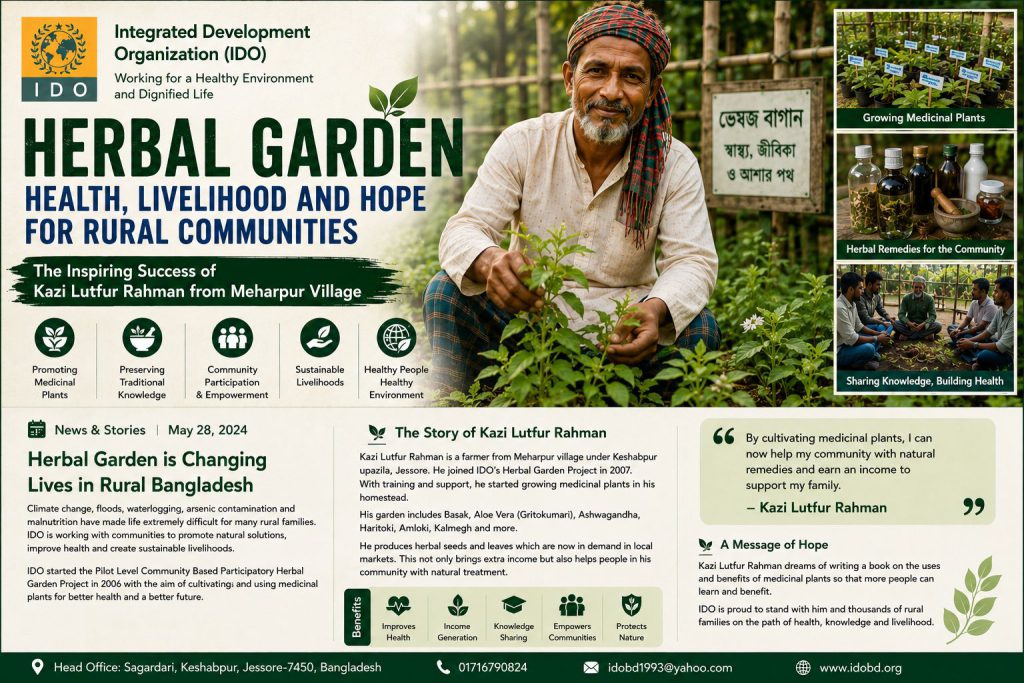
The Inspiring Story of Kazi Lutfur Rahman and IDO’s Community-Based Herbal Garden Initiative
In response to these realities, Integrated Development Organization (IDO) has been implementing development initiatives in its working areas. Among them, the Pilot Level Community Based Participatory Herbal Garden Project has been supporting communities since 2006 by encouraging the cultivation and use of medicinal plants With sharp graphics and instant access, this casino keeps the action in your hands at all times. Experience smooth gaming anywhere with Gamblezen.
The Story of Kazi Lutfur Rahman
Kazi Lutfur Rahman, a farmer from Meherpur village of Keshabpur, Jashore, became inspired by IDO’s herbal garden activities and decided to develop his own medicinal plant garden.
A former bicycle mechanic, Kazi Lutfur Rahman worked hard to educate his four daughters and one son. In 2007, motivated by the herbal garden initiative and his desire to help poor families in his community, he began cultivating Basak (বাসক) around a pond beside his homestead.
A Garden with a Purpose
Kazi’s herbal garden is not simply a source of plants. It has become a community resource.
According to the case study, poor families in the surrounding area collect Basak leaves, flowers and stems from the garden and use them as traditional herbal remedies for conditions such as fever, cough and cold. The document also records that local women collect leaves and, with support from IDO, sell them to a medicine company at a fair price, creating an opportunity for additional household income.
This approach connects herbal cultivation with community participation and livelihood opportunities.
Supporting Poor Families
For Kazi Lutfur Rahman, one of the key purposes of growing medicinal plants is to make basic herbal resources more accessible to poor families.
He believes that if medicinal plants can be cultivated in households throughout the community, families may have easier access to traditional plant-based remedies and potentially reduce some of the additional costs associated with healthcare.
The case study also presents Kazi as a welcoming community member who shares his knowledge about medicinal plants with people who visit his home.
From One Garden to a Community Movement
Kazi’s vision extends beyond his own garden. He believes that medicinal plants should be cultivated more widely so that rural families can benefit from them.
His story demonstrates how a relatively small community-based initiative can create connections between:
 Medicinal plant cultivation
 Community health awareness
 Support for vulnerable families
 Additional income opportunities
 Knowledge sharing
 Sustainable use of local resources
The case study specifically highlights his belief that every household could benefit from cultivating medicinal plants with appropriate support from IDO.
Kazi Lutfur Rahman’s Vision
Kazi’s message is ultimately about service and community wellbeing. He expresses the belief that people should share the benefits they receive with others and that dedication, sincerity and perseverance can lead to success.
His experience offers an example of how local knowledge, community participation and organizational support can work together to create new opportunities for rural families.
A Small Garden, A Bigger Vision
Kazi Lutfur Rahman’s herbal garden represents more than the cultivation of Basak. It represents a vision in which rural households can use locally available resources to support health, knowledge and livelihoods.
Through its Pilot Level Community Based Participatory Herbal Garden Project, IDO continues to demonstrate the value of community participation in creating locally relevant development solutions.
Integrated Development Organization (IDO)
Working with communities for a healthier, more resilient and dignified future.