
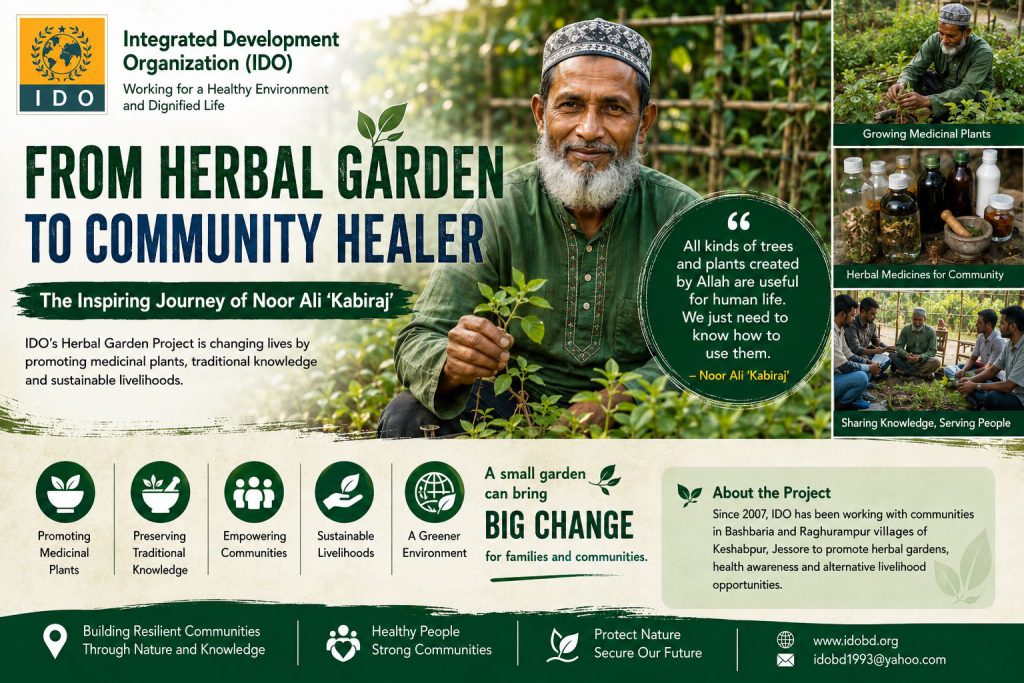
How a Community-Based Herbal Garden Project is Creating New Opportunities for Health, Knowledge and Livelihood
Climate change and environmental instability are creating serious challenges for people living in the southern and southwestern regions of Bangladesh. Heavy rainfall, flooding, waterlogging, drought, tidal surges and cyclones are increasingly affecting livelihoods, agricultural production and household income. These challenges are making life particularly difficult for vulnerable rural communities
With sharp graphics and instant access, this casino keeps the action in your hands at all times. Experience smooth gaming anywhere with Gamblezen.To help communities respond to these challenges, Integrated Development Organization (IDO) has been implementing a Pilot-Level Community-Based Participatory Herbal Garden Project with financial support from A.F. The initiative focuses on promoting medicinal plants, community participation and alternative livelihood opportunities.
Meet Noor Ali “Kabiraj”
Md. Noor Ali Sheikh, known locally simply as Noor Ali, is one of the dedicated beneficiaries of IDO’s Herbal Garden Project.
Noor Ali joined the project as a beneficiary in 2007. A farmer and father of seven children, he has spent much of his life depending on agriculture. However, like many people in his community, access to conventional medical treatment can be difficult because of financial limitations.
Through IDO’s support, training and guidance, Noor Ali began cultivating medicinal plants around his home and garden.
Today, his garden contains at least ten varieties of medicinal plants, including:
- Shatamool
- Gritokumari
- Ashwagandha
- Basak
- Amloki
- Haritoki
- Ulotkombol
- Kalomegh
Turning a Small Garden into an Opportunity
Noor Ali has cultivated Ashwagandha, Gritokumari and Basak on approximately two decimals of land. According to his experience documented in the case study, there is significant market demand for Ashwagandha seeds, creating a potential source of additional household income. He expected to collect approximately 700–900 grams of Ashwagandha seeds from his garden.
For Noor Ali, the herbal garden is therefore more than a collection of plants. It represents an opportunity to combine traditional knowledge, agriculture, community service and livelihood development.
From Farmer to “Noor Ali Kabiraj”
As Noor Ali developed his knowledge and experience with medicinal plants, people in the surrounding community began visiting his garden.
The case study records that local people started calling him “Noor Ali Kabiraj”, reflecting his growing reputation for knowledge of herbal plants and traditional remedies.
His garden has become a place where community members can learn about medicinal plants and their traditional uses.
Sharing Knowledge with the Community
Noor Ali’s ambition goes beyond maintaining his own garden. He wants to learn more about the characteristics and practical uses of medicinal plants and share this knowledge more widely.
He also requested that IDO publish a book explaining the benefits and limitations of different medicinal plants, so that more project beneficiaries can gain access to reliable information.
This reflects an important aspect of community-based development: knowledge becomes more valuable when it is shared.
A Greener Path to Resilience
For communities affected by climate change, diversifying livelihoods and making productive use of available land can create additional opportunities.
Noor Ali’s experience demonstrates how a small herbal garden can become a source of knowledge, community engagement and potential economic opportunity, while also encouraging people to value local plant resources.
The case study describes his desire to continue developing the herbal garden throughout his life and emphasizes the importance of caring for plants to achieve sustainable benefits.
A Story of Hope and Community Participation
Noor Ali’s journey from a rural farmer to a locally recognized herbal practitioner is an example of how community-based initiatives can help people discover new possibilities within their own surroundings.
With continued learning, proper guidance and responsible use of medicinal plants, community members can build on local knowledge while creating opportunities for healthier and more resilient livelihoods.
IDO remains committed to supporting vulnerable communities through participatory, sustainable and locally driven development initiatives.
Integrated Development Organization (IDO)
Working with communities for a healthier, more resilient and sustainable future.