
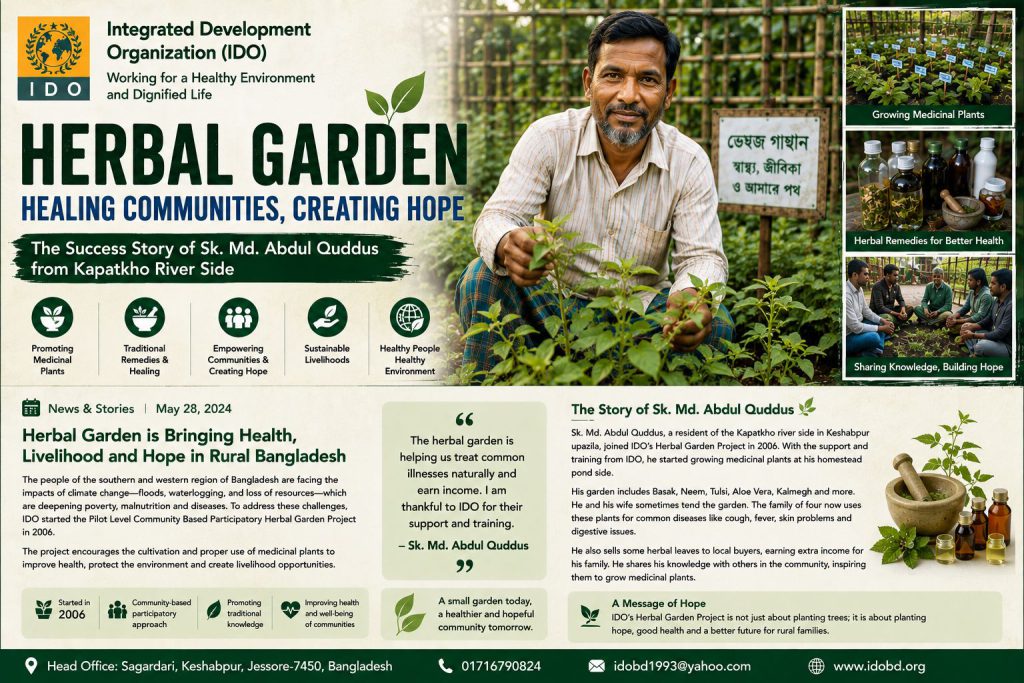
The Inspiring Journey of Sk. Md. Abdul Quddus Through IDO’s Herbal Garden Project
The southern and southwestern regions of Bangladesh are increasingly vulnerable to climate-related challenges. Flooding, waterlogging and the resulting loss of resources are affecting agriculture, household income and food security, while poor communities are also facing malnutrition and different health problems
In response to these challenges, Integrated Development Organization (IDO) has been implementing the “Pilot Level Community Based Participatory Herbal Garden” project. The initiative was launched in 2006 with the aim of encouraging communities to cultivate and appropriately use medicinal plants With sharp graphics and instant access, this casino keeps the action in your hands at all times. Experience smooth gaming anywhere with Gamblezen.
The Story of Sk. Md. Abdul Quddus
Sk. Md. Abdul Quddus, known as Quddus, joined IDO’s Herbal Garden Project at its very beginning in 2006. Over time, he developed himself as an exemplary beneficiary of the initiative. He lives with his family of four, and his wife, Laily Begum, also helps care for the herbal garden when he is away for work.
Quddus says that obtaining services from registered doctors can be difficult for poor families in the area, particularly during difficult climatic conditions. With support, advice and training from IDO, he therefore began cultivating medicinal plants as an alternative source of traditional herbal care.
Growing Medicinal Plants for Health
Quddus has been cultivating Ghrito Kumari (Aloe vera) and other medicinal plants on approximately three decimals of land. According to the case study, these plants have considerable demand in local markets and villages.
The case study describes several traditional uses of Ghrito Kumari that community members practice, including applying its plant material to minor burns and using it in traditional ways for cooling and soothing purposes. These are presented in the source as community practices and traditional uses, rather than as medically verified treatments.
Creating an Additional Source of Income
The herbal garden is also creating an economic opportunity for Quddus’s family.
According to the case study, he sold Ghrito Kumari leaves twice for Tk. 1,500, considering the earnings an additional source of family income. He also sells some of the plants to people in the local community.
This demonstrates how medicinal plant cultivation can connect health awareness, traditional knowledge and livelihood opportunities within a rural community.
A Vision for a Larger Herbal Garden
Quddus’s ambition does not stop with his existing garden. He plans to cultivate at least 20 varieties of medicinal plants on unused land around his home.
He also wants local people to gain practical knowledge about the characteristics and uses of medicinal plants. His broader dream is to become self-reliant through the herbal garden and encourage others to develop similar gardens.
Caring for Plants, Building a Future
Quddus believes that plants need to be cared for with the same attention and dedication given to children. His message emphasizes patience, sincerity, care and perseverance as important elements of achieving success.
His experience shows how a community-based initiative can create opportunities beyond a single household—bringing together traditional knowledge, medicinal plant cultivation, community awareness and additional income generation.
IDO’s Commitment to Community Development
Through the Pilot Level Community Based Participatory Herbal Garden Project, IDO is working to encourage local communities to explore sustainable, community-based approaches to health and livelihoods.
Quddus’s journey is one example of how support, training and community participation can help transform a small piece of unused land into a source of knowledge, opportunity and hope.
A Small Garden. A Bigger Dream.
From medicinal plants to additional income, from local knowledge to community participation—Quddus’s story reflects the power of people-led development.
Integrated Development Organization (IDO)
Working with communities for a healthier, more resilient and dignified future.