
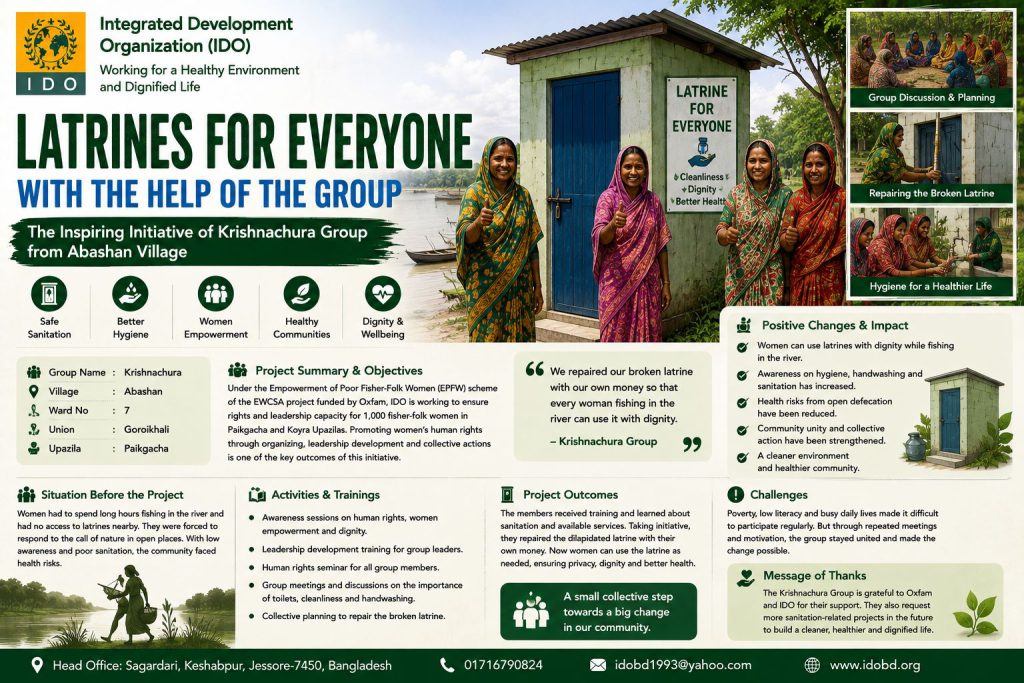
How the Krishnachura Group Turned Women’s Collective Action into a Sanitation Solution
Access to safe sanitation is closely connected with health, dignity and wellbeing. Yet in many remote communities, poverty and limited infrastructure continue to make access to basic sanitation facilities difficult
In Abashan village, Ward No. 7 of Goroikhali Union, Paikgacha Upazila, Khulna, women who spent long hours fishing in the river faced a particularly difficult sanitation challenge. There were no adequate latrine facilities near the river, forcing women to use open spaces when necessary With sharp graphics and instant access, this casino keeps the action in your hands at all times. Experience smooth gaming anywhere with Gamblezen.
Empowering Women Through Collective Action
To address the situation, Integrated Development Organization (IDO) has been implementing the “Empowerment of Poor Fisher-Folk Women (EPFW)” scheme under the EWCSA project with financial support from Oxfam.
Launched in April 2024, the project works in remote areas of Paikgacha and Koyra Upazilas of Khulna. One of its key objectives is to strengthen the human rights and leadership capacity of 1,000 fisher-folk women through organizing, leadership development and collective action.
The Krishnachura Group became an example of how this empowerment can translate into practical community action.
From Training to Action
Members of the Krishnachura Group participated in different activities and training sessions through IDO’s EPFW project.
These included:
- Human rights and women’s empowerment awareness sessions
- Leadership development training
- Human rights seminars
- Learning about government and private services
- Discussions on sanitation, cleanliness and handwashing
- Collective planning to improve sanitation conditions
Through these activities, group members gained knowledge about their rights and the importance of sanitation and began discussing how they could address the problem themselves.
Repairing a Broken Latrine Together
The group identified a broken and dilapidated latrine near the river.
Instead of waiting for outside assistance, the members decided to take collective action. They repaired the latrine using their own money, creating a facility that women fishing in the river could use when needed.
This small but meaningful initiative gave the community something more than a repaired toilet—it demonstrated the power of collective decision-making and women’s leadership.
A Change in Everyday Life
The repaired latrine has helped women overcome the sanitation difficulties they previously faced while fishing in the river.
The group now has access to a usable sanitation facility, helping them avoid the problems associated with open defecation and improving privacy and dignity.
The initiative also encouraged greater awareness of:
Sanitation → Handwashing → Cleanliness → Health → Dignity
Challenges Along the Way
The group’s journey was not without challenges.
Members come from highly vulnerable households. Their daily lives depend heavily on fishing, leaving limited time for regular group activities. Low literacy levels also create additional difficulties.
However, through repeated meetings, discussion and mutual motivation, the group continued working together and was able to achieve a practical result.
A Dream for a Better Community
The Krishnachura Group hopes that everyone in their community will use sanitary latrines properly and that the sanitation facilities will remain clean, private and safe.
They also expressed a desire for future sanitation-related projects and continued support in their area.
A Small Collective Step, A Big Community Change
The story of Krishnachura Group shows that community development is not always about large infrastructure or expensive interventions.
Sometimes, knowledge + leadership + collective action + determination can create meaningful change.
The women of Krishnachura Group transformed training and awareness into action—and demonstrated that when communities work together, they can identify problems, mobilize their own resources and build solutions that directly improve everyday life.
Integrated Development Organization (IDO)
Working with communities for dignity, empowerment and a healthier future.
Project: Empowerment of Poor Fisher-Folk Women (EPFW)
Location: Abashan Village, Goroikhali Union, Paikgacha, Khulna
Supported by: Oxfam
Implemented by: Integrated Development Organization (IDO)