
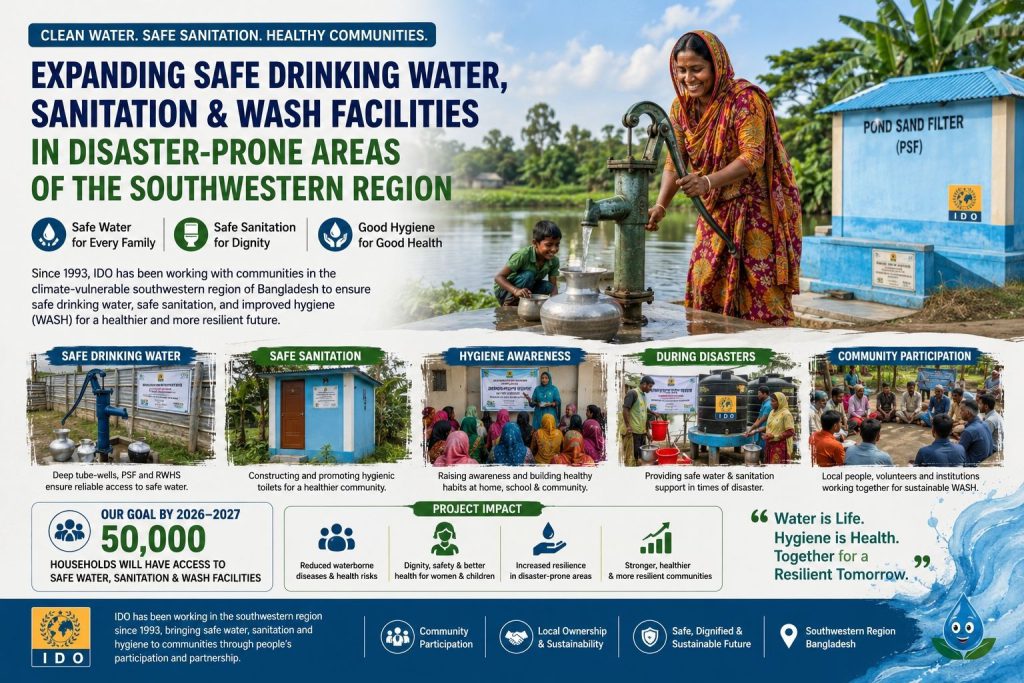
The southwestern region of Bangladesh is highly vulnerable to cyclones, storm surges, floods, waterlogging, salinity intrusion, and arsenic contamination. These climate-related and environmental challenges are increasingly affecting access to safe drinking water, sanitation, public health, and the livelihoods of local communities
With sharp graphics and instant access, this casino keeps the action in your hands at all times. Experience smooth gaming anywhere with Gamblezen.For decades, Integrated Development Organization (IDO) has been working with communities in climate-vulnerable areas of southwestern Bangladesh to improve access to safe water, sanitation, and hygiene facilities.
Since 1993, IDO has supported communities through initiatives including deep tube wells, Pond Sand Filters (PSF), Rainwater Harvesting Systems (RWHS), safe sanitation facilities, and WASH awareness activities. Through these efforts and partnerships with development organizations and donor agencies, approximately 350,000 people have been brought under the coverage of WASH facilities, directly or indirectly.
Why This Project Matters
The availability of safe drinking water remains a critical challenge in coastal and disaster-prone communities. Rising salinity, sea-level impacts, frequent cyclones and storm surges, and prolonged waterlogging are making existing water sources increasingly unsuitable for use.
Poor and marginalized families often lack the resources to secure safe water, hygienic sanitation, and essential WASH facilities. As a result, women, children, and other vulnerable groups face increased health risks and reduced quality of life.
Our Project Goal
The project aims to ensure safe drinking water, safe sanitation, and essential WASH facilities for disaster-prone and vulnerable communities in southwestern Bangladesh while strengthening local capacity to respond to water crises caused by arsenic, salinity, and disasters.
Key Objectives
💧 Expand access to safe drinking water
Establish, rehabilitate, and improve safe water sources and supply systems.
🛡️ Address arsenic and salinity risks
Take measures to protect communities from contaminated and saline water.
🚻 Promote safe sanitation
Construct safe and hygienic sanitation facilities and encourage their proper use.
🧼 Improve hygiene practices
Promote positive WASH behaviors at household, school, institutional, and community levels.
🌊 Strengthen disaster preparedness
Build local capacity to maintain safe water and sanitation services during disasters.
🤝 Strengthen community participation
Engage communities, volunteers, local institutions, and relevant stakeholders in implementation and maintenance.
Aiming to Reach 50,000 Households
Under this initiative, IDO aims to bring approximately 50,000 households under the coverage of safe drinking water, safe sanitation, and essential WASH facilities by the 2026–2027 fiscal year.
The project will implement needs-based activities including safe water-source development, water supply and storage systems, sanitation facilities, hygiene awareness programs, and WASH support during disasters.
Community-Based Implementation
The project follows a community-based, participatory, and needs-based approach.
Local communities will be involved in assessing needs, selecting beneficiaries, installing WASH infrastructure, and arranging its use and maintenance. IDO’s VS Centers will support local coordination, awareness, training, monitoring, and follow-up.
Local government institutions, community organizations, women and youth representatives, teachers, volunteers, and other relevant stakeholders will also be engaged.
Expected Impact
Through successful implementation, the project expects to:
- Provide approximately 50,000 households with safe water, sanitation, and WASH facilities.
- Reduce health risks associated with arsenic-contaminated and saline water.
- Improve safe water sources and supply systems.
- Increase the use of safe and hygienic sanitation.
- Improve WASH access for women, children, and vulnerable groups.
- Increase community awareness of hygiene and safe-water practices.
- Strengthen community capacity to manage WASH services during disasters.
- Promote sustainable community-led use and maintenance of WASH facilities.
Sustainability Through Community Ownership
IDO recognizes that sustainable WASH solutions require more than infrastructure. The project therefore places strong emphasis on community ownership, participation, proper use, maintenance, hygiene practices, and disaster preparedness.
Local communities, representatives, and institutions will participate in planning, implementation, utilization, and maintenance to ensure that project benefits continue over the long term.
Join Us in Building a WASH-Resilient Future
IDO is seeking financial, technical, and institutional support from government institutions, local government bodies, national and international donors, development partners, and private-sector organizations to expand access to safe water, hygienic sanitation, and dignified living conditions for vulnerable communities in southwestern Bangladesh.
“Ensuring safe water, safe sanitation, and hygiene is not merely a development activity; it is a key prerequisite for building a healthy, dignified, and disaster-resilient society.”